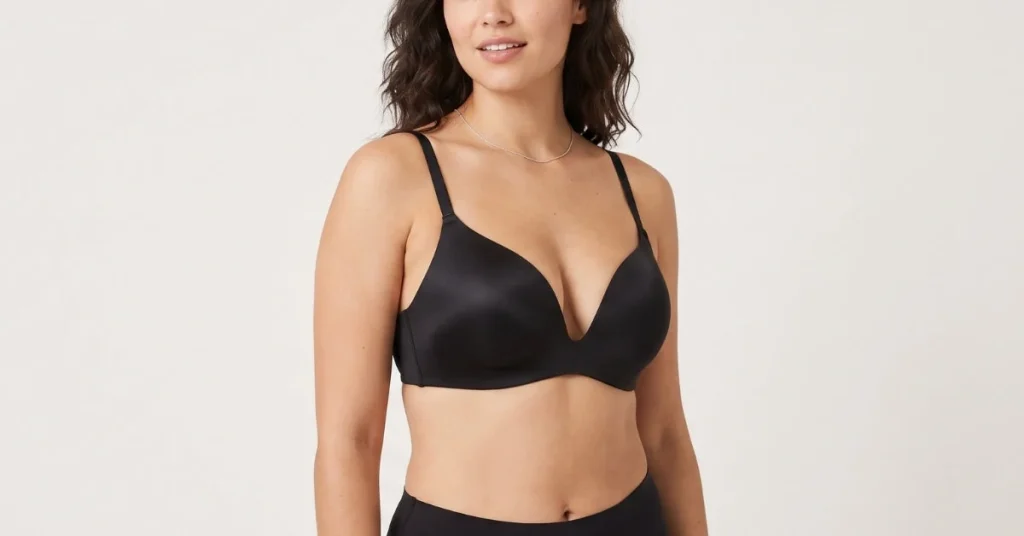

There’s a particular kind of wardrobe frustration that most women know well. You’ve found the perfect top, the neckline is exactly right, and then you put it on and your bra straps are visible, or the cup is peeking out, or the whole look just doesn’t quite land the way you imagined. The plunge bra exists, in large part, because of that exact problem.
It’s one of those styles that looks almost too simple to be useful when you see it on a hanger. The centre gore sits low, the cups angle outward, and there’s often not much to it in terms of coverage – but that’s entirely the point. The design creates cleavage and stays hidden under necklines that would expose a standard bra within seconds. For anyone who’s ever had to layer a vest under a wrap dress just to avoid a bra situation, this makes a genuine difference.
What Actually Makes a Plunge Bra Different
Most standard bras are built with a centre gore that sits relatively high between the cups. That works well for everyday coverage, but it becomes a problem the moment you wear anything with a V-neck deeper than about two inches. A plunge bra drops that centre piece right down, sometimes to just a centimetre or so of fabric between the cups, which means it disappears under necklines that a regular bra simply can’t handle.
The side boning and wing structure usually sit higher to compensate, so you’re not losing support, you’re just redistributing where it comes from. It sounds like a minor adjustment but in practice it changes what you can wear. Wrap dresses, deep V-neck tops, certain evening wear, even some workwear with a lower button-down neckline suddenly become options without a second thought.
There’s also a shaping element worth mentioning. Because the cups angle the bust inward and upward from the sides, the effect tends to create a rounded, lifted shape. Some women find this more flattering than the more separated look that wider-centre bras can sometimes produce. Not universally, obviously, and fit still matters more than style every time, but it’s a real consideration.
Getting the Fit Right (Which Matters More Than the Style)
The most common mistake with plunge bras is buying the same size you wear in every other style and assuming it’ll translate. Bra sizing doesn’t work like that, and plunge bras are particularly sensitive to fit because the whole structure relies on the cups sitting flush to the chest at the sides. If your cups are slightly too big, you’ll get gaping at the centre. If they’re slightly too small, the low gore won’t sit flat and the whole thing looks wrong.
Sister sizing is worth knowing about here. If you normally wear a 34C and the plunge style you’re trying feels a bit off, a 36B or 32D might actually work better depending on where the issue is. It’s the kind of thing a good fitting room makes easy, though online is entirely workable if you know what to look for. Sites like Belle Lingerie stock a wide range of plunge bras across an extensive size range, which at least gives you options if you’re between sizes or find certain brands run differently.
The underwire should lie flat against your ribcage at the sides and not dig in anywhere along the bottom of the cup. With a plunge style, people sometimes accept minor discomfort there assuming it’s just the nature of the shape, but it isn’t. If the wire is sitting on breast tissue rather than underneath it, the size is wrong.
When It’s the Right Choice and When It Isn’t
A plunge bra isn’t a replacement for every style you own, and it probably shouldn’t be. Under a crew-neck jumper or a high-neck top, it doesn’t add anything and depending on the fabric, the lower centre might actually be visible as a slight dip. It earns its place specifically when the neckline demands it.
For a lot of women, owning one good plunge bra in a neutral shade is honestly enough to cover most situations. You don’t need a whole drawer full of them, but having none at all means making constant small compromises with what you can actually wear, and that gets tedious faster than you’d expect.